
Summary
Editor's rating
Value for money: makes sense only if you’re already in the Hue ecosystem
Design and build: slim, plastic, and sticks out a bit
Durability & reliability: plastic shell, decent rating, but not tank-like
Video, audio & app: usable, but with some quirks
Installation: very much not "plug-and-play"
What this Hue doorbell actually offers
Day-to-day use: does it actually make you feel more secure?
Pros
- Integrates well with existing Philips Hue lights and security modes
- Wired power means no battery charging or replacement
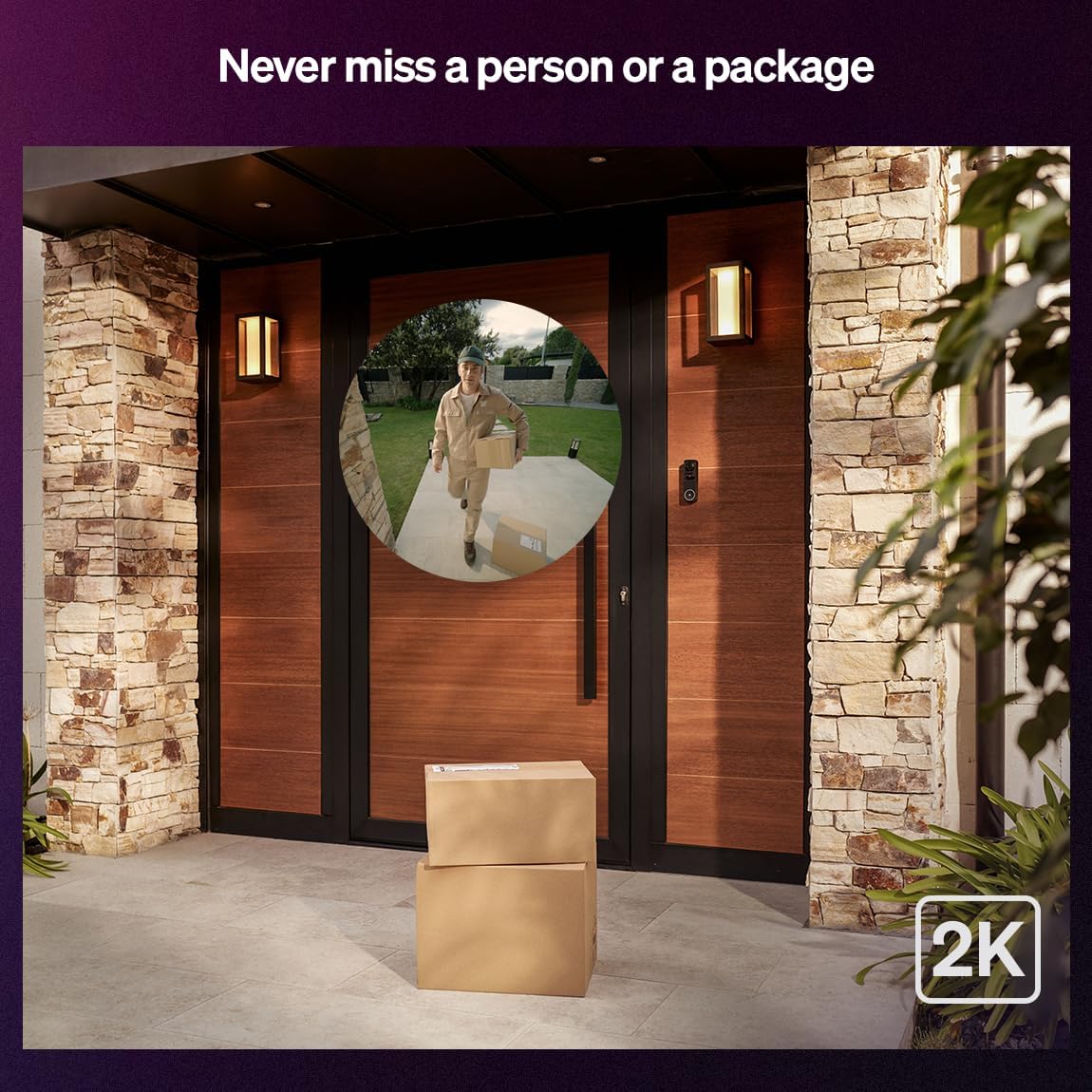
- Wide 2K video with head-to-toe view and decent colour night vision
Cons
- Installation can be complex and may require extra parts and an electrician
- Image often looks underexposed compared to some competitors like Ring
- No local storage and no chime or transformer included, which hurts value

Specifications
View full product page →| Brand | Philips Hue |
A wired Hue doorbell that’s good, but not magic
I’ve been using the Philips Hue Secure Wired Video Doorbell Camera in black for a little while now, and I’ll be blunt: it’s decent, especially if you already have a Hue setup, but it’s not some miracle security upgrade. I replaced a more classic video doorbell (Ring-style) with this one because I was tired of subscription fees and I already had a bunch of Hue bulbs and sensors at home. On paper, this Hue doorbell ticks a lot of boxes: 2K video, wide 180° view, two-way audio, works with Hue lights, and wired power so you don’t have to think about charging batteries.
In practice, the experience is a bit mixed. When it’s set up correctly and your Wi‑Fi is solid, it does the job: you see who rings, you can talk to them, and you can trigger your lights when there’s movement. But between the wiring, the app setup, and some quirks with image brightness, it’s clearly not the most plug-and-play option out there. If you expect to unbox it and have it running in 10 minutes with zero tinkering, you might be disappointed.
What pushed me to try it was mainly the integration with the Hue ecosystem. I already had a Hue Bridge, motion sensors and a bunch of outdoor lights, so the idea of having everything in one app sounded good. I like when my porch lights turn on if someone walks up to the door at night, and the doorbell can handle that pretty well. But if you don’t already own Hue stuff, the value feels a lot weaker because you’re basically paying for integration you won’t fully use.
Overall, my feeling after using it is simple: it’s a pretty solid doorbell if you’re already deep into Hue. If not, it’s just an okay video doorbell that costs a fair bit and asks for extra bits (transformer, chime, etc.) to really work like you expect. So it’s not bad, but it’s not some perfect all‑rounder either.
Value for money: makes sense only if you’re already in the Hue ecosystem
On value, my opinion is pretty straightforward: it only really makes sense if you already own Hue gear or plan to build a Hue-based setup. As a standalone video doorbell, it’s okay but not particularly cheap, and you have to deal with extra costs: transformer, possible electrician, separate chime, maybe a subscription if you want longer video history. When you add all that up, it ends up in the same price bracket as competitors that often have better image processing and more mature apps.
If you compare it to something like Ring, one user summed it up well: they preferred Hue because they wanted to avoid subscriptions and liked the clarity and Hue integration. That’s the main angle where it can feel like good value – if you accept the limited free recording window and don’t care about storing weeks of footage. But another user said the image quality was clearly worse than their Ring Pro, especially in terms of brightness. So you’re trading some image quality and app polish for Hue ecosystem integration and slightly less subscription pressure.
Another point: there’s no local storage option. Everything goes through the cloud. For a lot of people, that’s fine; for others, it’s a deal-breaker. When you buy a wired doorbell (so you don’t have to worry about batteries), you kind of expect a more long-term, self-sufficient device. Having to rely on a subscription for proper history doesn’t sit perfectly with that idea. The free 24h or so is okay for casual use, but not if you want a proper log of events over several days.
So, is it good value? I’d say it’s decent but not more. If you already have a Hue Bridge, Hue lights and you like the idea of tying security and lighting together, the price is easier to swallow and it fits nicely into your setup. If you’re starting from scratch and just want a reliable video doorbell, there are simpler and often cheaper solutions with fewer hidden extras. In that case, I’d look around before committing to this one.

Design and build: slim, plastic, and sticks out a bit
Design-wise, the Philips Hue Secure Wired Video Doorbell is pretty simple: a rectangular black plastic block, about 134 mm tall, 42 mm wide, and 33 mm deep. It’s not ugly, but it’s not some fancy object either. It looks modern enough, blends in well on a dark door frame, and doesn’t scream “big camera watching you” as much as some bulkier models. If you care about a discreet look, it’s okay, but you can still clearly see the lens and the button.
The doorbell sticks out about 3 cm from the wall, and that actually matters in real life. Because of its shape and the single front-facing camera, parcels that are left very close to the door or off to the side might not always be visible, especially if your doorway is narrow. One Amazon user mentioned not seeing most left parcels, and I’ve had a similar experience with packages placed right against the wall under the camera. The 180° vertical field of view helps, but the physical offset still limits what you see.
The mounting bracket is another weak point. The plastic feels a bit light, and one reviewer pointed out that a neighbour managed to pull the top screw and plug out. I didn’t have anyone attacking my doorbell, but when I installed it, I did notice the bracket could be more robust. If someone really wants to rip it off the wall, it doesn’t feel like it would be that hard. For a security product, I’d prefer something tougher, maybe metal or at least thicker plastic.
On the positive side, the overall footprint is compact, and it doesn’t take over your front door. The button is easy to spot and press, and the camera placement makes sense. It’s just that the build quality feels more “decent plastic gadget” than “serious security hardware”. For the price, I expected a bit more heft and a slightly more solid mounting system.
Durability & reliability: plastic shell, decent rating, but not tank-like
On durability, I haven’t had it installed for years obviously, but I can still comment on the general feel and the specs. The doorbell is made of plastic with an IP54 rating, which means it’s protected against dust and splashes but not full-on jets or immersion. For a front door under a small overhang or in a relatively protected spot, that’s fine. If your door is very exposed to heavy rain and wind, I’d be a bit more cautious and maybe mount it where it’s not directly hammered by weather all day.
The plastic casing itself feels okay but nothing more. It doesn’t feel like it will crack in a month, but it also doesn’t give that solid, heavy impression some other brands have. The weak point, as mentioned earlier, is the mounting bracket and screws. One user had a neighbour yank the top screw and plug, which shows that if someone wants to mess with it, it’s not that hard. Of course, that’s true for many consumer doorbells, but here the bracket really could use a bit more reinforcement. If you live in an area where vandalism is a concern, that’s worth keeping in mind.
In terms of electronics and connectivity, mine has been stable so far: no random reboots, no complete connection drop for days. It reconnects after router restarts without me having to babysit it. That’s the minimum you’d expect, but not all devices manage it. Since it’s wired, you don’t have to worry about battery wear or replacements, which is a big plus over the long term. The main risk is more about future software support and cloud services: if Philips ever changes their approach or stops certain features, you’re a bit stuck, especially with no local storage.
Overall, I’d rate durability as acceptable for normal home use. It should hold up well on a typical British or European house wall for several years, as long as you mount it properly and don’t expose it to extreme conditions. Just don’t expect industrial-grade robustness or anti-vandal protection. It’s a consumer gadget, and it feels like one.
Video, audio & app: usable, but with some quirks
On the performance side, the Hue doorbell is a bit of a mixed bag. The 2K resolution sounds great on the box, and the image is sharp enough to recognise faces and see details like clothes and parcels. The 180° head-to-toe view is handy: you really do see people from head to feet when they’re in front of the door, which is nicer than older 16:9 doorbells where you mostly saw upper bodies. However, the big issue for me is the exposure and brightness. Like one Amazon reviewer, I also find the image often too dark, especially on cloudy days. Compared to something like a Ring Pro, the Hue image can look underexposed, which makes it harder to see faces clearly in the shade.
At night, the colour night vision is pretty good when there’s at least some ambient light or when you combine it with Hue outdoor lights. In low light, the Starlight tech does help: you don’t just get a grainy black-and-white mess. But again, placement and lighting matter a lot. If your entrance is in a darker alcove, you might need to rely heavily on your Hue lights to get a nice view. Without that, the marketing about “full colour view in near darkness” feels a bit optimistic.
For audio, the two-way talk works fine, but it’s nothing special. There’s a tiny bit of lag as usual with Wi‑Fi doorbells, but I never had a full dropout. People hear me clearly enough, and I hear them, but it’s not crystal-clear hi-fi. It’s more like “phone on speaker” quality, which is okay for telling a courier where to leave a parcel or telling someone you’re coming to the door.
The app side is where it’s stronger if you already use Hue. You manage everything from the Hue app: live view, notifications, zones, linking to lights, and security modes. It’s practical to have everything in one place. That said, one user mentioned struggling to even find the right app and link the repeater/chime, so the process is clearly not foolproof. I didn’t find it impossible, but it’s definitely not as straightforward as some more mainstream doorbells. Overall, the performance is good enough for daily use, but you can find brighter and more polished solutions from competitors.
Installation: very much not "plug-and-play"
Let’s be clear: this is a wired doorbell that often needs an electrician. It’s not one of those battery models you just stick to your door with a bracket and call it a day. You need a 12–24V AC transformer, proper cabling to your door, and sometimes a new chime setup. If you already have a classic wired doorbell, it’s easier because you can usually reuse the wiring and just update the transformer if needed. But if you don’t, you’re probably looking at drilling, running cables, and maybe hiring someone.
Personally, I had an existing wired doorbell, so I swapped the old unit and changed the transformer to match Hue’s requirements. It still took me a solid afternoon, between turning off power, checking wiring diagrams, mounting the bracket, drilling a slightly deeper hole, and setting up the Hue chime. One Amazon reviewer listed everything they had to buy: a long masonry drill, Hue chime, 24V transformer, fuses and an inline fuse holder. That matches my experience: you often need more parts than the box includes, and that’s something Philips could be clearer about.
The pairing process with the Hue app is mostly okay if you’re used to smart home gadgets. There’s no barcode directly on the device, it’s on a card in the box, which is fine for security but annoying if you lose that card. Also, you need to note down a security phrase if you want to encrypt footage on other devices. It’s an extra step that’s good for privacy, but not very friendly for beginners. One user literally gave up and threw it away because the setup was too confusing for them, which tells you it’s not idiot-proof.
Once installed, though, it’s pretty stable. It connects to Wi‑Fi, shows up in the Hue app, and you can then link it to your lights and security modes. But honestly, if you’re not comfortable with electrical wiring or you’re expecting something you can install in 20 minutes by yourself, this is not the right product. It really suits people who already have a wired doorbell and a Hue Bridge, or who are ready to invest time and maybe pay an electrician.
What this Hue doorbell actually offers
Let’s start with what you actually get. In the box, it’s very minimal: you basically get the doorbell unit itself and the wall mount. No chime included, no transformer, no long list of accessories. So if you don’t already have a 12–24V AC doorbell transformer at home, you’ll need to buy one separately, plus probably a compatible Hue chime if you want a classic indoor ding-dong. That’s already a small annoyance because many people expect a more complete kit at this price.
On the spec side, it’s a 2K resolution camera with a very wide 180–187° field of view, 30 fps, night vision in colour, and two-way audio. It connects over Wi-Fi and works through the Hue app, with Matter, Zigbee and SmartThings compatibility on paper. It’s rated IP54, so it’s fine for outdoor use but not meant to be pressure-washed or drowned. Power is wired DC/AC, no battery option at all, which is good if you hate charging, but it also means more work at install time and possibly an electrician.
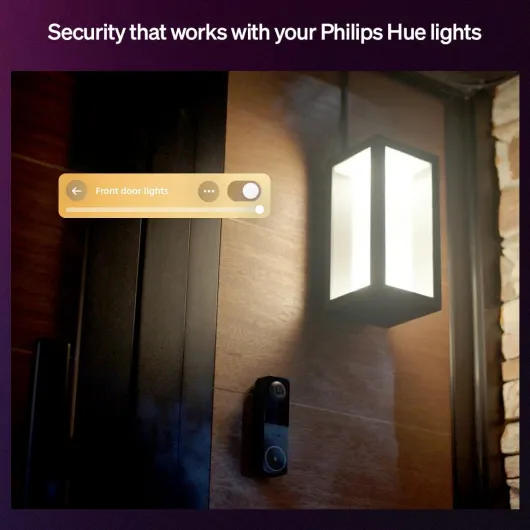
Function-wise, the basics are there: motion alerts, live view, two-way talk, and recordings in the cloud. Philips gives you a limited free history (around 24 hours) and then offers a subscription if you want more. There’s no local storage on an SD card or NAS, which might be a downside if you want to avoid subscriptions entirely. Integration with Hue lights is the extra bit: you can have your lights flash or turn on when someone rings or when motion is detected.
So on paper, it covers the main use cases: see who’s at the door, talk to them, check packages, and get some basic deterrent effect with lights. But you can feel this is one of Philips Hue’s first attempts at a doorbell: some details (like no included chime and no local storage) show that it’s still a bit of a work in progress compared to more mature brands like Ring or Nest.
Day-to-day use: does it actually make you feel more secure?
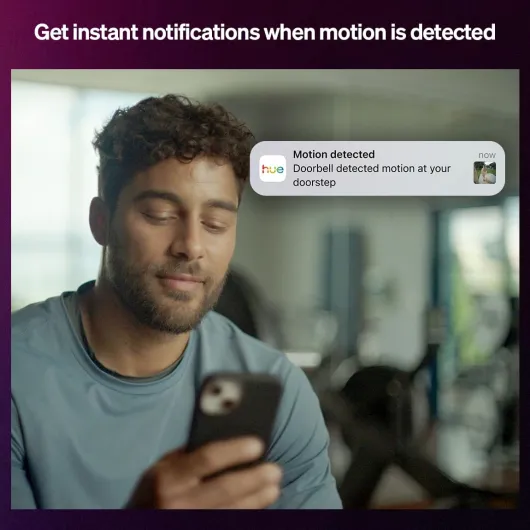
In everyday use, the Hue Secure doorbell does the basics: it sends motion alerts, lets you see and talk to visitors, and records events in the cloud. When someone walks up, my phone buzzes, I can open the app, see the live feed, and talk if needed. When they ring, I get the notification, the Hue chime rings, and my front lights flash briefly at night. So functionally, it does what I expect from a modern video doorbell, with the extra twist of controlling the lights.
The motion detection is decent, but you’ll probably need to fine-tune it. Out of the box, I got a few too many alerts from people just walking past on the pavement. Once I narrowed the detection zones and told it to focus on my doorstep area, it got much more usable. You can also choose if you want movement alerts, button press alerts, or both, which is handy if you don’t want your phone buzzing all day. One small downside is that alerts are motion-only; there’s no fancy person/vehicle/pet classification like on some other systems.
In terms of actual security feeling, the integration with Hue lights is the main benefit. When motion is detected at night, my porch light and part of the garden light up automatically, which makes it very clear to anyone that they’re being noticed. That alone is a good deterrent. Also, if you combine it with Hue’s Home/Away modes, you can set routines so the house looks occupied and the doorbell helps trigger those scenes. One reviewer did point out the lack of proper geofencing for security modes, which I agree with: the app can do geofencing for lights, but the doorbell side feels a bit behind.
Overall, I’d say it gets the job done for basic home monitoring. It’s not the most advanced security system on the market, but as part of a Hue setup, it adds a useful layer. If you’re expecting advanced AI detection, ultra-bright HDR video and local recording, you might find it a bit limited. But for seeing who’s there, checking packages, and scaring off casual intruders with lights, it works fine.
Pros
- Integrates well with existing Philips Hue lights and security modes
- Wired power means no battery charging or replacement
- Wide 2K video with head-to-toe view and decent colour night vision
Cons
- Installation can be complex and may require extra parts and an electrician
- Image often looks underexposed compared to some competitors like Ring
- No local storage and no chime or transformer included, which hurts value
Conclusion
Editor's rating
After using the Philips Hue Secure Wired Video Doorbell Camera, my conclusion is pretty clear: it’s a solid option if you’re already invested in the Hue ecosystem, and only an average choice if you’re not. The strong points are the integration with Hue lights, the 2K resolution with a wide field of view, and the fact that it’s wired so you never have to charge it. As part of a bigger Hue setup, it fits in nicely: motion turns on lights, doorbell presses can trigger visual alerts, and you manage everything in the same app.
On the flip side, the installation is not beginner-friendly, the image can be too dark compared to some competitors, and the hardware feels a bit light for the price. No included chime, no transformer, and no local storage also hurt the overall value. If you just want a simple, straightforward video doorbell and you don’t care about Hue, there are easier and sometimes cheaper products that will do the job with less hassle. But if your house is already full of Hue bulbs and sensors and you like the idea of tying your security to your lighting, this doorbell is a reasonable, if imperfect, choice.